

Ranked: The 10 worst drivers to race in F1 this century


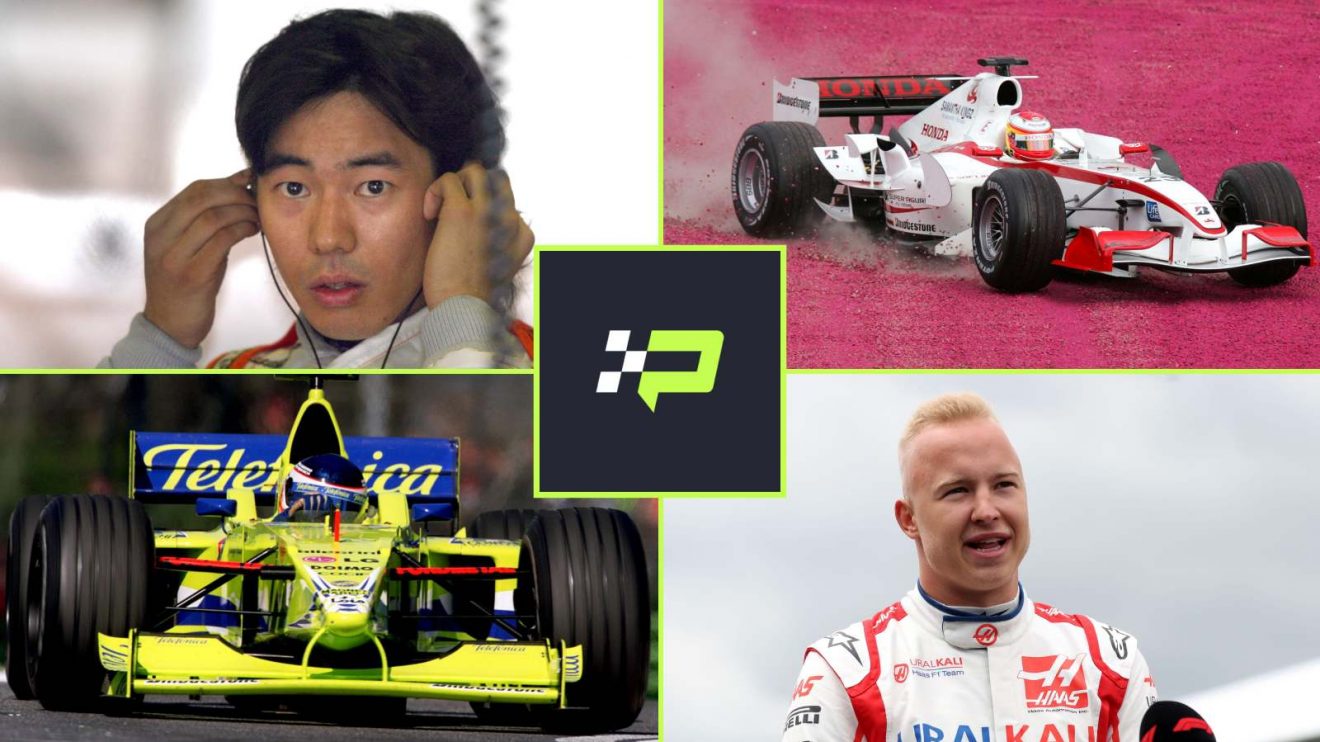
Sakon Yamamoto, Yuji Idea, Gaston Mazzacane, and Nikita Mazepin make up some of the entries on our top 10 list.
Formula 1 drivers are the best of the best in the world, but that doesn’t mean there aren’t some who have looked, well, a little out of their depth over the years.
Here are our picks for some of the drivers who failed to make any sort of impression on F1 during their time. For the purposes of this list, we’ve only selected drivers who were chosen as full-time drivers, or full-time replacements, at the time of their hiring. On top of that, their pre and post-F1 records are not taken into account and, aside from number one, are presented in no particular order.
Gaston Mazzacane
The Argentine racer, dubbed ‘The Flying Mullet’ due to his striking hairstyle, began in F1 as a test driver for Minardi and was selected to race alongside Marc Gene for the 2000 season.
Had the points systems of today applied, Mazzacane would have scored points in just his second race – the 2000 Brazilian Grand Prix – but, unfortunately for him, points were only scored down to sixth place.
Having secured his seat at Minardi thanks to backing from pay television channel Pan-American Sports Network, Mazzacane had few highlights during a season in which Gene was usually the star performer for the backmarker team.
Outqualifying Gene just three times in 17 races, the Argentinean finished ahead of the Spaniard just once in the handful of races both finished, but he could take solace in one stand-out moment when he overtook Mika Hakkinen at the United States Grand Prix as the reigning World Champion struggled around on dry tyres on a damp track.
However, even this high point was marred by what came later – having run as high as third as others pitted, Mazzacane would misjudge his entry speed into his pit box, clipping his crew and pulling some equipment with him – injuring front-right wheel changer Ricardo Pozzati and refueller Sandro Parrini.
Mazzacane secured another deal for 2001, this time with Prost GP, as team owner Alain Prost was eager to bring onboard the money from Mazzacane’s sponsor PSN.
Put on a performance-related contract, Mazzacane only made it as far as the fourth round – Imola – as he was trounced, often by over a second a lap, by the far more experienced Jean Alesi. Ousted after Imola, Mazzacane’s only top-level international motorsport outings since came in 2004 as he took part in half a season of ChampCar with Dale Coyne Racing.
A regular on the Argentinian domestic racing scene, he finished 12th in last year’s Turismo Carretera Argentina – a stock car series in his native country.
Alex Yoong
Fernando Alonso’s first F1 teammate was Brazilian driver Tarso Marques who, on paper, was annihilated by the Spaniard in his rookie season at Minardi.
But Marques, who brought no money to the cash-strapped team, had been signed on the proviso that he could be replaced at any moment by any available pay driver – a situation he was quite circumspect about when the situation did arise in late 2001.
As new and upgraded parts usually went to Alonso, Marques was beaten 12-2 in qualifying results and, of the circa 1200 laps they raced together, Alonso was ahead 60 percent of the time – despite his inexperience relative to Marques.
But Malaysian driver Alex Yoong was on team owner Paul Stoddart’s radar and was brought in for the final three races of 2001 as he secured backing from Malaysia’s government-controlled lottery company Magnum.
Constant reliability and mechanical trouble plagued his three races and, at the season finale, he reached the chequered flag in 16th – Alonso was in 11th.
Partnering up with Mark Webber for a full tilt at the 2002 season, Yoong fell foul of F1’s 107% qualifying rule on three separate occasions – the only driver to do so unintentionally, as the Arrows drivers deliberately didn’t qualify for the French Grand Prix.
Finishing seventh (of eight finishers) at the season opener in Australia proved to be the high point of his year, with Webber trouncing Yoong throughout the season – not once did Yoong finish ahead of Webber on the occasions where both reached the chequered flag.
Worse, Yoong had to cope with the ignominy of being “rested” for two races by Stoddart, who brought in Anthony Davidson to take his place following Yoong’s third ‘Did Not Qualify’ at the German Grand Prix.
“It has obviously been a difficult decision to rest Alex for two races but it’s clear he is struggling with his qualifying pace at the moment,” Stoddart said. “Ours is not a team to abandon its drivers and it seemed most constructive to let Alex have a short break from the pressure.
“During the intervening time between now and the Italian Grand Prix he will take part in a testing programme tailored specifically to addressing any loss of confidence he may have suffered.”
While Yoong did manage to qualify for his last three races upon his return, he did not secure a seat for 2003.
Luca Badoer
This one is probably a bit unfair to include but the Italian does meet our criteria as Ferrari turned to their long-time test driver to fill in for the injured Felipe Massa for the second half of the 2009 season.
Michael Schumacher had been the preferred option but, with the seven-time F1 World Champion waylaid with a neck injury from a motorbike accident, Ferrari opted to reward Badoer with the seat alongside Kimi Raikkonen for the rest of the season.
Unfortunately, it was to prove an embarrassing sequence of races for the experienced Italian, who returned to the cockpit of an F1 car for his first Grand Prix in 10 years – he had last raced for Minardi in 1999.
This was no typical rookie outing, with Badoer having to shake off everything he knew about Grand Prix racing in an era that had long since passed, and, to make matters worse, he hadn’t tested the 2009 car at any point that year.
His rustiness was on full display as he qualified 1.5 seconds behind the rest of the grid in Valencia – and then tapping off the back of a Force India as he parked up in parc ferme.
Finishing 17th in that race, Badoer qualified last again at Spa-Francorchamps and, while Kimi Raikkonen romped towards victory after overtaking Giancarlo Fisichella, Badoer finished last – he would have been lapped had the race been but a lap longer.
Badoer’s performances had been bad to the point that Ferrari needed to take drastic action and, despite having lined up Badoer for the rest of the season, negotiated a deal with Force India to capture the high-flying Fisichella for the rest of the season.
However, underlining just how poor the F60 was, Fisichella went from fighting with Raikkonen for victory at Spa to qualifying 14th at Monza – he, too, failed to gel with the Ferrari and didn’t score another point all season while Raikkonen brought home several decent points finishes.
Fisichella’s performances were further vindication for Badoer that it wasn’t all his fault…
Narain Karthikeyan
Despite his results being mediocre, at best, in his pre-F1 career, Jordan’s financial struggles and resulting sale to the Midland group ahead of the 2005 season brought Karthikeyan a Formula 1 opportunity as Trevor Carlin became sporting director – Karthikeyan having driven for Carlin in British Formula Three.
Having stumped up millions in order to secure his seat with the Jordan/Midland team, alongside fellow pay driver Tiago Monteiro, it proved a terrible year for the team that, just half a decade earlier, had been able to be something of a giant killer.
Aside from the six-car United States Grand Prix, Karthikeyan didn’t score any points. Monteiro fared little better, although managed eighth place at Spa-Francorchamps to boost his tally after finishing third – and beating Karthikeyan – at Indianapolis in the push for the final podium place behind the two Ferraris.
With Midland seeking huge sums of money to sign him again for 2006, even Karthikeyan’s sponsors couldn’t come through on this occasion – and the Indian driver instead signed with Williams as a reserve and test driver. But, with his sponsor Tata withdrawing most of their financing, most of the testing instead went to Kazuki Nakajima.
Taking part in some stock car and NASCAR truck racing, Karthikeyan secured a return to the grid for the HRT (Hispania Racing Team) squad in 2011, with Tata having been “instrumental” in coming up with the cash to win a seat.
That season, Karthikeyan would twice set the record for the lowest-placed finisher ever in a Grand Prix, finishing 23rd and 24th at the Chinese and European Grands Prix, respectively.
With Red Bull seeking a way to give Daniel Ricciardo some experience, the Australian was placed at HRT midway through 2011 with Karthikeyan moved aside – only returning for his home Grand Prix in India.
In 2012, Karthikeyan spent most of his year lingering outside the top 20, with 15th place at Monaco being the high point of his career. Karthikeyan also drew the ire of the reigning World Champion Sebastian Vettel in Malaysia when, while being lapped by the German, inadvertently sliced the tyre of the Red Bull.
This led to Vettel branding Karthikeyan a “cucumber”, with the Indian driver’s riposte being to call Vettel a “crybaby”. With Vettel going on to win the title, Karthikeyan duly came home 24th of 25 drivers – including being beaten to 23rd by Jerome D’Ambrosio as the Belgian driver took part in one race in which he took 13th – and failed to secure a seat for the following season.
Moving to Super Formula for the following five years, Karthikeyan never cracked the top 10 in the Japanese domestic series and brought his single-seater career to an end in 2019. He has not raced since 2021, after taking part in the LMP2 category of the Asian Le Mans Series.
Nicolas Kiesa
Hardly the most experienced driver on this list, Kiesa was given the nod to race until the end of the season at Minardi in 2003 as Justin Wilson – who could also be considered for this list – left the team to race for Jaguar.
Having had a solid but unspectacular junior career, Kiesa had capitalised upon an error from Bjorn Wirdheim to win the 2003 Formula 3000 race at Monaco and had just swapped to Super Nova Racing at Silverstone when he got his Minardi chance – instead racing in F1 rather than F3000 at the Hockenheim weekend in August.
Having never driven an F1 car, Minardi boss Paul Stoddart gave Kiesa some time behind the wheel with a day of testing at Mugello in order to complete 300 kilometres of track time and earn his super licence before the Hockenheim weekend kicked off.
Partnered with the experienced Jos Verstappen, Kiesa never out-qualified or finished ahead of the Dutch driver, although finished his five races without any major dramas – he also never troubled the points positions.
Had he had more time, Kiesa might have been able to impress but, with little fanfare, the Danish driver was quickly forgotten about.
Showing maturity after 2003 as he admitted his need to improve to match Verstappen’s speed, Kiesa wasn’t able to secure a drive for 2004 and, while he managed to get a gig as a test driver at Jordan/Midland in 2005, his racing career was already almost at an end.
After a short-lived stint in DTM in 2006, which yielded no success, Kiesa disappeared from the racing scene. Today, he is a commentator and expert for TV3 in Denmark and, according to his website, is a driving instructor at both Porsche and Lamborghini, and also a lecturer.
More of PlanetF1’s Rankings lists
? Ranked: The best and worst F1 tracks on the F1 2025 calendar
? Ranked: The best and worst value for money drivers on F1 grid
Nikita Mazepin
A former test driver for Force India and Mercedes as he progressed up the junior career ladder, Mazepin’s strong GP3 season in 2018 was followed by a poor first season in Formula 2 as he finished just 18th in the year his teammate Nyck de Vries won the title.
In 2020, Mazepin fared better with the Hitech Grand Prix team in which his father – chairman of Uralkali – had invested, and he finished fifth in the championship.
With Haas F1 needing a pay driver to come on board and help with the team finances after the impact of the COVID-19 pandemic, Mazepin and Uralkali were signed by the American squad on a multi-year deal to start in 2021.
Qualifying almost a second behind his fellow rookie teammate Mick Schumacher to line up last on the grid, Mazepin made it to the third corner of his debut race in Bahrain before spinning off into the gravel in an unforced error – he had spun four times during the practice sessions and qualifying.
While there was no question the Haas VF-21 was far from a competitive machine and was very tricky to drive, Mazepin fared far worse than Schumacher and it took until Monaco before the Russian driver finished ahead of Schumacher in a race.
Mazepin earned himself the nickname ‘Mazespin’ due to the number of spins he had over the course of the year, with over 25 spins recorded while on-track in the Haas, although, in fairness to him, he rarely actually did much damage to his cars as a result of these losses of control.
Having spun himself as a result of tagging Schumacher at Silverstone, Mazepin would spin Schumacher around during the race at Monza and would later apologise during what was a tense period for the teammates after the Russian driver had moved over at high speed to block Schumacher at Zandvoort.
Statistics from the season revealed Schumacher enjoyed around a half-second advantage over a single-lap in qualifying and, in the races in which Mazepin finished ahead, it was usually only by an average of a few seconds – when Schumacher finished ahead, the average was over 30+ seconds.
Mazpein and Schumacher were kept on for 2022, although Haas cut all ties with Mazepin and Uralkali unceremoniously when Russia began military action in Ukraine in early ’22 – leading to EU and UK sanctions being placed on Russian companies and individuals, including the Mazepins specifically due to their connections to Vladimir Putin’s administration.
Mazepin has not yet returned to racing in an FIA-sanctioned series, with the motorsport governing body having introduced an emergency response in ’22 that allows Russian drivers to race in a neutral capacity provided they sign a declaration committing to adhere to the FIA’s principles of peace and political neutrality.
Roberto Merhi
Affable and personable Roberto Merhi may have been, but the Spaniard made little impact on F1 during his short time at the top of the motorsport ladder.
Having won the Euro Formula Three championship at the third time of asking, racing for Prema in 2011, Merhi was signed by the Mercedes’ junior driver programme to race in DTM – including some mentorship from none other than Michael Schumacher.
Unfortunately for Merhi, this input seemed to have little effect as he scored zero points in 2012, and things didn’t improve much in ’13 as he scored 26 points over the year – most of which came as a result of finishing second at the season finale, by far and away his strongest result.
A move back to single-seaters seemed to do the trick for Merhi as he drove in Formula Renault 3.5 in 2014, finishing third behind Carlos Sainz and Pierre Gasly, and this was enough for the cash-strapped Caterham team to take him on board as a test driver.
With Caterham going into administration before the end of ’14, it briefly looked as though Merhi would get his chance to compete in the team’s beleaguered final race in Abu Dhabi as administrator Finbarr O’Connell fought to find a new buyer for the squad, but this eventually went to Will Stevens (also a contender for this list).
Merhi would get his chance in 2015, signed by Manor Marussia, alongside Stevens, almost immediately falling foul of the 107 percent rule in Malaysia – although the stewards allowed him to start.
It would prove to be an awful season for the squad, with both Merhi and Stevens propping up the rear of the field and usually racing amongst themselves. While Stevens came out marginally on top of this particular teammate battle, it’s worth remembering he was much smaller and lighter than Merhi – and the team was lacking in finances to the point where Merhi wasn’t always given the latest or best specification of parts.
Nevertheless, Merhi didn’t even get to see out the season as Manor gave Alexander Rossi his chance to debut before season end – with a bit of seat swapping between the pair to finish out the year, depending on Rossi’s commitments.
Having sat out most of the tail end of 2015, it was no surprise he was overlooked for a seat for 2016 as Manor turned to Pascal Wehrlein and Rio Haryanto.
Merhi remains an active racing driver, having turned to endurance racing and even a return to Formula 2 – with no notable results, although he finished second in the 2021 S5000 Tasman Series.
Rio Haryanto
An underwhelming junior career through GP3 and GP2, including two years with Manor in GP3, netted the Indonesian driver little by way of wins or podiums, but his best result of 4th overall in the 2015 championship – his fourth year in the category – was enough to convince Manor to give him a chance for 2016, particularly as he came with plenty of sponsorship from the Indonesian government.
Colliding with Romain Grosjean in the pitlane at his debut race, which earned a three-place grid penalty, Haryanto had the type of year that might be expected when driving for a team barely surviving financially.
His career-best finish was 15th in Monaco – four laps down and last of the classified finishers – but it was the Austrian Grand Prix that highlighted the stark difference between himself and teammate Pascal Wehrlein, reigning DTM Champion at the time and, most recently, a Formula E World Champion.
While Wehrlein finished 10th to score the team’s only point of the year, Haryanto finished 25 seconds further behind down in 16th, before he spun off at Silverstone and finished last in Hungary and Germany.
With Haryanto’s funding from the Indonesian Ministry of Youth and Sport blocked by parliament in his native country, due to “invalid procedures of funding procurements by the Minister of Youth and Sport”, the driver’s career came to an abrupt end.
Given there were no reasons to retain him on the basis of talent, with Wehrlein having dominated his teammate, Haryanto quietly withdrew as Esteban Ocon took over his seat for the remainder of 2016.
Six months later, Haryanto entered the family business as he began working with his father to oversee the security printing division of their company Kiky, whilst also dabbling in some Blancpain racing in Asia, to no great success.
Sakon Yamamoto
Yamamoto had a junior career that no one would ever write home about and didn’t even stand out as a domestic talent in Japan prior to his Super Aguri chance.
Aguri Suzuki, more concerned with the nationality of the drivers he signed for his Super Aguri squad than what they achieved, plumped for Yamamoto as a replacement for Franck Montagny who, himself, had been a replacement for Yuji Ide (more on him in a moment!)
With seven races to get to the end of the season, Yamamoto retired from the first four having been slowest of all in qualifying in three of them – at Monza, he was a massive 1.8 seconds off the back of the rest of the field, not helped by having a tyre delaminate during the session.
But Yamamoto managed to finish the last three races of the year, although was nowhere near the team’s first driver Takuma Sato. With Anthony Davidson being given the nod for 2007, Yamamoto was relegated back to test driver for 2007.
He combined this role with a return to GP2, although his F1 experience didn’t help him at all as he scored zero points in the first six rounds, before he got another chance in F1.
Christijan Albers left Spyker (previously Midland) after Silverstone had opened up a seat and, after giving Markus Winkelhock a drive at the Nurburgring, the Silverstone-based squad turned to Yamamoto after snaffling him away from Super Aguri.
He promptly crashed out on the fourth lap in Hungary, before racing to last place in almost all the rest of the races that year – while teammate Adrian Sutil scored a point for eighth place in Japan.
One driver who Yamamoto did manage to finish ahead of was Jarno Trulli in that same race, but that was as good as it got for the Japanese driver as he returned to GP2 again the following year – again, to no success.
While he secured a seat as a test driver for Renault in 2009, the Enstone squad were at pains to point out that this role would only be for public demo runs rather than proper testing.
Another chance at HRT would arise in 2010, where he continued to place last after getting the nod to replace Karun Chandhok (another candidate!) in Germany. Lapped by his teammate Bruno Senna in Hungary, Yamamoto injured a mechanic during a pitstop at Monza when he accelerated away from his stop – although this was hardly his fault, as his lollipop man had given the signal to accelerate away.
Nonetheless, it was the cherry on top of what had been a horrible run in F1, which came to an end after finishing last in Japan and Korea before being replaced by Christian Klien.
Aside from two outings in Formula E with Amlin Aguri four years later, and some minor-league domestic racing, Yamamoto’s motorsport career ended and he has since turned to politics.
Turning to a career in medicine and social welfare, he became an advocate for elderly care in 2012 and, in 2021, was elected to the Japanese House of Representatives.
1. Yuji Ide
While the other nine drivers on our list have been featured, in no particular order, due to just lacking that little spark that defines an F1 driver, there’s only one name that could make it to number one simply based on being so out of his depth that the FIA had to intervene.
Japanese driver Yuji Ide had the indignity of having his FIA super licence stripped away from him early on in the 2006 F1 season, having competed in just four race weekends – one of the shortest F1 careers ever.
He had fared respectably on the Japanese racing scene, having just finished second in the Formula Nippon (now Super Formula) category in 2005 and, with Honda looking for an all-Japanese line-up for their secondary project at Super Aguri, signed Ide as Takuma Sato’s teammate for 2006.
At 31 years old for his rookie season, Ide immediately struggled to adjust to Formula 1 – not helped by his lack of proficiency at speaking English as he integrated with his team. He spent his first three race weekends spinning off, driving around on unusual racing lines getting in the way, and just generally struggling with the car.
Even team boss Aguri Suzuki, who had been a supporter of Ide initially, had to increase the pressure to improve on Ide as he told the media his driver fundamentally lacked understanding of his car – he had only completed 200 kilometres of testing prior to his debut in Bahrain.
But, at Imola, Ide was the trigger for a serious collision involving Christijan Albers – the Dutch driver’s car coming to rest upside down in the gravel trap. The FIA was forced to intervene, and quickly.
The governing body took matters out of Super Aguri’s hands, stripping Ide of his super licence and preventing him from racing in F1. Franck Montagny was brought in as a short-term replacement for the next handful of races.
“Super Aguri confirms that the FIA permit office has retracted Yuji Ide’s super license,” the team said in a statement before the race at the Nurburgring.
“He will therefore not be participating in any further official FIA Formula 1 world championship events this year.”
Ide returned to Formula Nippon with Dandelion Racing, finishing the year with zero points. Unsurprisingly, an F1 return never materialised.
Read Next: Ranked: The F1 2024 drivers ordered from worst to best