

Europe v USA: How Le Mans sparked a decades long battle over technical innovation


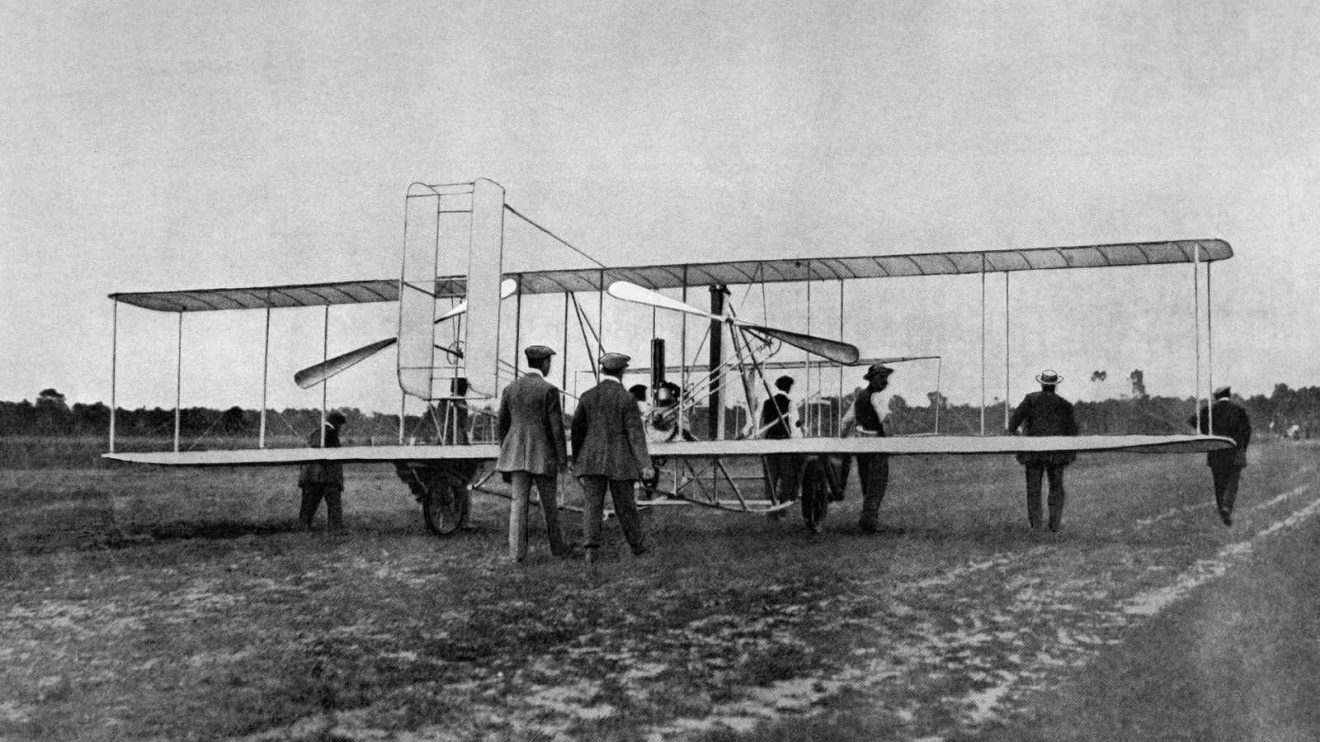
The Wright brothers demonstrate their aircraft to the French war office at Le Mans.
The history of motorsport is deeply entwined with that of the aviation industry in many unexpected ways, from the implementation of airplane technology onto race cars, to the first public flights in Europe.
On August 8, 1908, Wilbur Wright — one of the iconic American Wright brothers — travelled to France to prove to a skeptical European audience that he and his brother had actually figured out how to get airborne. It was a move that set the tone for decades of battle between American and European technological innovation — and it all took place in a little town called Le Mans, France.
Wilbur Wright’s groundbreaking Le Mans flight
Wilbur and Orville Wright are icons of American aviation. They’re credited with inventing, building, and flying the world’s first successful airplane courtesy of a three-axis control system that allowed the pilot to steer an airborne craft while also maintaining its equilibrium.
In 1900, the two brothers officially began testing their experimental aircraft designs at Kitty Hawk, North Carolina before accomplishing their first sustained flight on December 17, 1903.
In the United States, the news of the Wright Brothers’ success was met with very little enthusiasm. In Paris, however, the Aero Club of France was fascinated by the rumors that these American men from Ohio had somehow managed to get airborne before they had — and began trying desperately to catch up in the technology development.
Today, there are ample rumors that the Wright Brothers intentionally failed at flying in front of reporters in order to hide their newfound aviation secrets in plain sight, and the two had stopped putting on demonstration flights in 1905 in order to prevent anyone from stealing their design before they could patent it.
In Europe, however, came massive amounts of skepticism that the Wright brothers had discovered anything at all. The February 10, 1906 Paris edition of the New York Herald newspaper ran a story titled “Flyers or liars?” that concluded, “It is difficult to fly. It’s easy to say ‘we have flown’.”
Further, Ernest Archdeacon, founder of the Aero Club de France, furthered the belief that the Wright brothers simply could not have created this kind of technology, and that “the French would make the first public demonstration of powered flight.”
What better excuse for the Wright brothers to fly again — this time in Europe?
Delve into the history of tech innovations in motorsport:
? The Story of the Williams FW14B: A revolutionary technological masterpiece
? Aeroscreen: The life-saving IndyCar technology that was rejected by Formula 1
In 1908, Wilbur Wright traveled to France with an airplane he and his brother had designed between 1903 and 1905. He had been invited by Léon Bollée, an auto manufacturer and sport balloonist; Bollée allowed Wright to use his automobile factory in Le Mans to repair a plane that had been seriously damaged in transit.
Rumor has it that Wright scheduled his flight on August 8 to coincide with the due date of Bollée’s baby, as his wife Carlotta served as an interpreter between Wright and her husband. Other recountings of the event state that Wright selected August 8 simply because the weather had been perfect.
Nevertheless, August 8 was the day that Wilbur Wright brought his plane out to the Hunaudières horse track at Le Mans, and he took flight in front of a small crowd — including the aforementioned Archdeacon.
That first flight lasted fewer than two minutes, but it was enough. In order to illustrate that he could not only fly but also accurately control his machine, Wilbur Wright performed a series of figure-8s over the race course before landing gracefully.
Newspapers quickly spread word throughout the world that this American had in fact managed to stage a successful flight — and Wilbur Wright would remain in France for several more weeks, during which time he staged eight more flights, including flights with passengers.
In December of 1908, Write set records for altitude and distance, and took home the Michelin Cup that awarded 20,000 francs to the aviator who flew the longest distance.
The Hunaudières horse track still exists, though it now features a memorial to Wilbur Wright. It’s located just a stone’s throw away from the Mulsanne straight on what would become the Circuit de la Sarthe.
But perhaps the greatest legacy established that day was an ongoing war of innovation between America and Europe — one that still lasts to this day.
In the course of motorsport history, American innovations have often been overlooked or doubted until they can be replicated or re-invented by a great thinker in Europe.
For example, early innovations in aerodynamics and ground effect were discovered by American racer Jim Hall years before those feats were ever introduced to Formula 1 — but it wasn’t until those feats appeared in F1 that they were finally considered to be legitimized.
Wilbur Wright’s first flight in Europe is a reminder that competition may be the best inspiration for innovation — but that American inventors also deserve their due.
Read next: Andretti F1 twist as Department of Justice launches Liberty Media antitrust probe