

Mercedes reveal the major W15 turning point with two key upgrades identified


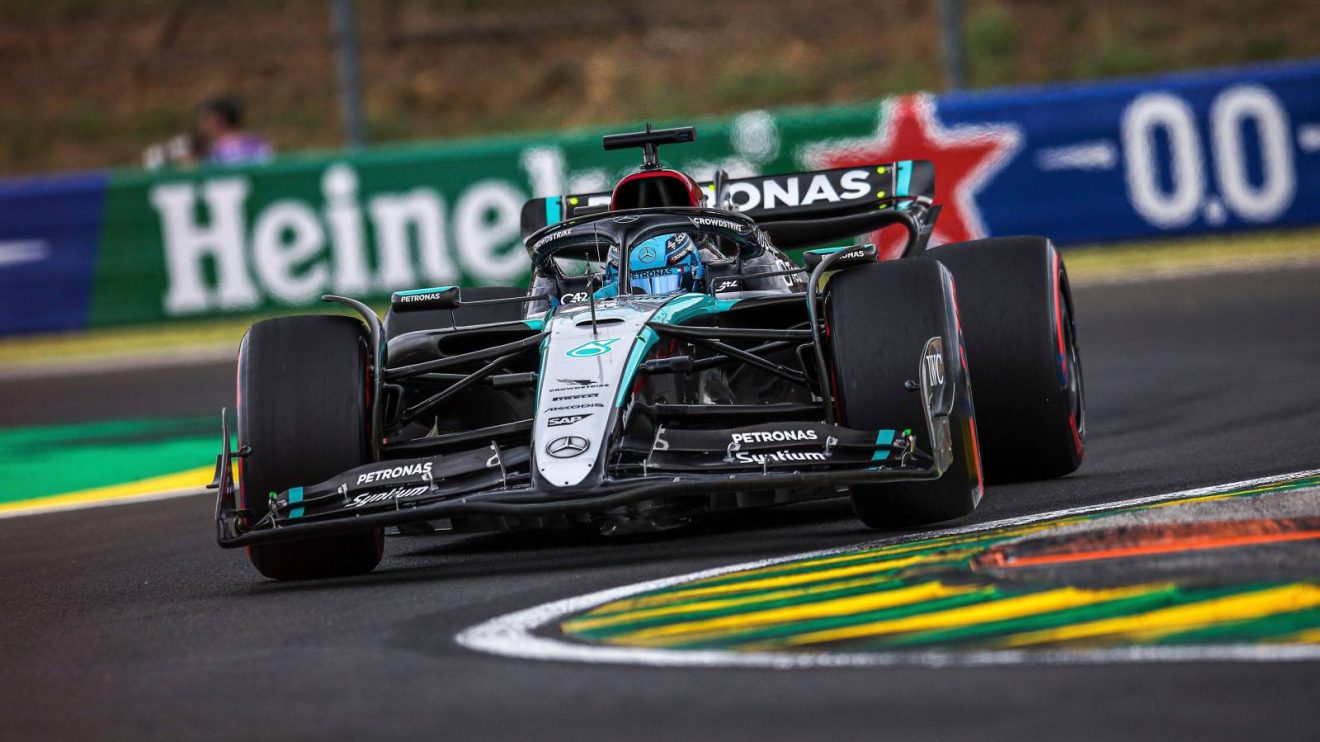
Mercedes driver George Russell in action.
Mercedes’ Andrew Shovlin has revealed how the “not very good” baseline of the W15 has been transformed over the first half of this season.
Having entered the year with optimism thanks to a different concept, Mercedes endured a difficult start to F1 2024 as the car’s potential proved difficult to unlock – potential that has now started to be realised as the W15 is now one of the quickest cars on the grid.
Andrew Shovlin: W15 problems have become ‘easier to see’
A focused upgrade path has allowed Mercedes to make strides with the W15, transforming it from a car that was the third or fourth-quickest on the grid into the pacesetter at the last race before the summer shutdown at the Belgian Grand Prix.
The team also became multiple grand prix winners for the first time since 2021, with both George Russell and Lewis Hamilton winning races in the run-up to the summer break.
It’s been a huge transformation, wiping clean many of the mystifying issues that had plagued the team since the start of the ground-effect regulations brought in for 2022, and Mercedes’ head of trackside engineering Andrew Shovlin has opened up on what’s changed as he spoke with select media, including PlanetF1.com, at Spa-Francorchamps.
“We didn’t really bring developments to the early races of the year, so we started to pull forward developments with a new floor in Miami,” he said when asked about what had started to click for Mercedes to bring about the transformation.
“We then pulled forward a front wing that was due later in the season to [where] we had one on George’s car in Monaco.
“I think, by that point, you could see that we had a car that was definitely one that you could work with and improve around that time of Monaco, and then, what we have seen since then, is a pretty impressive delivery of updates to every single track.”
Now with a firmer grasp on how to rectify some of the issues that have plagued the W15, Shovlin said this has a knock-on effect in terms of making the path forward even clearer.
“As you solve problems with the handling of the car, the challenge actually becomes simple and you get more clarity about what you want to do next,” he said.
“In the early part of the year, we had a car whose behavior changed wildly with relatively small swings in track condition.
“In Jeddah, we were bouncing badly in the high-speed corners – it’s quite hard to unpick all those issues. Whereas, if you look at tracks like Budapest, you’d say we’re still putting too much temperature in the rear tyres and there’s also just an element that we need to find a bit more base performance.
“But I think the problems that you’re dealing with, as the car has got quicker, have also become sort of easier to see.”
Asked by PlanetF1.com as to his reflection on the first 14 races of 2024, having taken the car from a baseline at which the team appeared to have made no step forward on the previous ‘zero sidepod’ concept, Shovlin said learnings have been made continuously since the change over the winter.
“Our baseline wasn’t very good,” he admitted.
“I think we’ve done a good job of understanding the issues and getting on top of them, we’ve clearly got a reasonable route for finding performance now.
“The frustration was that it was the third year in a row that we launched a car that wasn’t as good as we needed it to be.”
More on the latest Mercedes F1 news
? Mercedes junior team: The drivers looking to emulate George Russell’s road to F1 glory
? The five best F1 2024 this season: Canada only fifth, British GP beaten to No.1 spot
Given that the W15 initially didn’t appear to be a step forward from the tricky W13 and W14 offerings out of the factory at Brackley, Shovlin said the upward momentum makes it easier to keep motivation up – something which had been a key focus during the tricky times.
“Well, you’d obviously like to be quicker,” he said, when asked if the W15′ performance had initially been a kick in the teeth in the face of such optimism.
“That situation, though, presents challenges both on the technical and the development side – you need to understand the problem and you need to try and find resolutions quickly that will bring performance.
“It also creates a challenge for everyone at the factory, who are all working just as hard whether you’re winning or running near the back – the workload doesn’t change.
“Keeping everyone motivated and reassuring them that we have got a direction to get back towards winning ways is one of the key things, but it’s a situation that you just have to deal with.
“I think we’ve done a good job of maximising the learning from the opportunity. Simultaneous with that, we’re restructuring the organisation to try and give us the best technical team and group functions to take us into the future.
“All you can do is try and make the most of the situation that’s in front of you and it’s been a good recovery. But, hopefully, we’ll build on this base rather than take a step back.”
Read Next: Red Bull’s ‘too much’ RB20 admission as 2024 concept change decision explained


