

Eight F1 team-mate pairings who couldn’t stand each other while they drove together


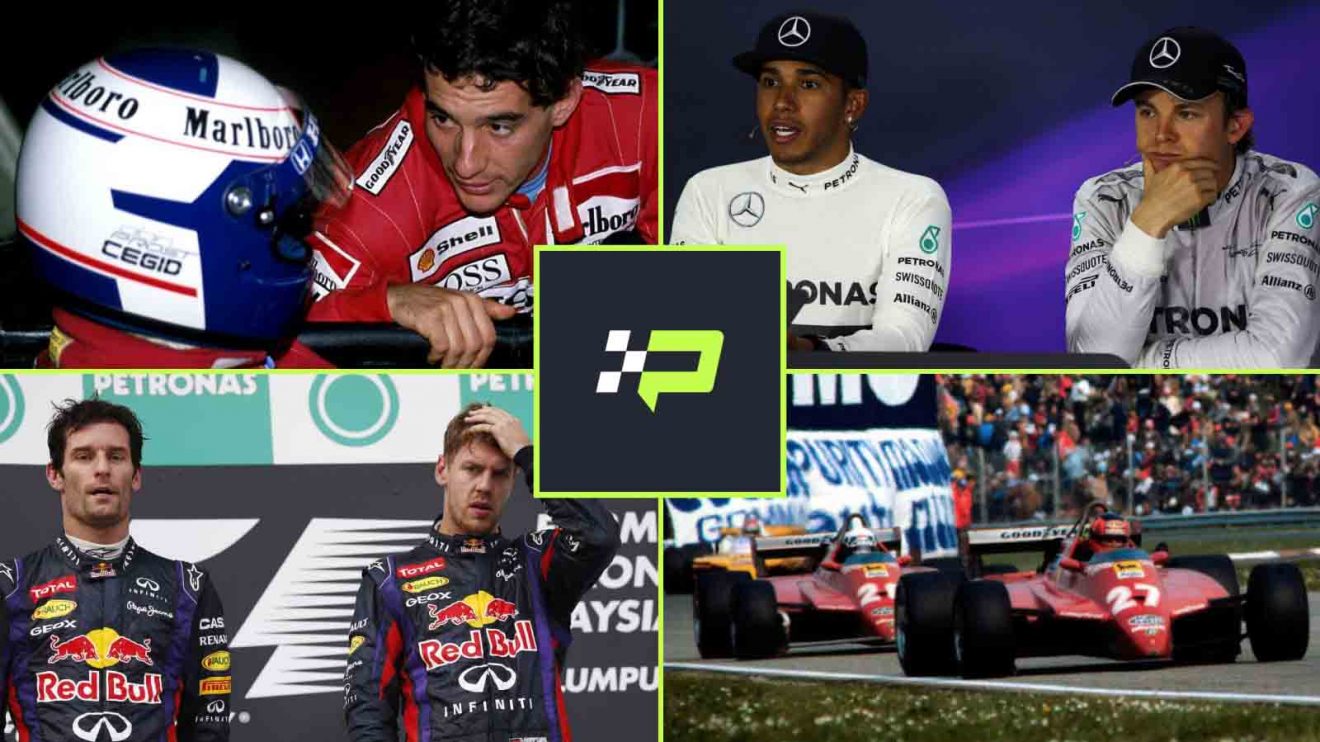
Some F1 team-mate rivalries have bubbled over throughout the history of the sport.
Being F1 team-mates can either form lifelong friendships (‘Carlando’ and ‘Yukierre’ now enshrined in Formula 1 parlance), or they can go the other way.
The first rule of Formula 1 is to always beat your team-mate. They’re the only other person with exactly the same car, meaning they provide the true barometer for your performance – and when things get tight, they can get *really* tight. Needless to say, then, that some pairings erupted over the years, and while some of these relationships healed after drivers moved to other teams or retired, you cannot say the same for others…
Eight F1 team-mate pairings who did not get on in their time together
Alain Prost and Ayrton Senna
Let’s start with the most famous one of all.
When a rising Ayrton Senna was paired with one of the sport’s top dogs in Alain Prost at McLaren in the 1988 season, the French driver was already a two-time World Champion at that point.
But with McLaren’s 1988 challenger, the MP4/4, being the class of the field, it was often the two of them fighting for race wins among themselves in one of the most successful Formula 1 cars of all time – with Senna coming out on top that year.
Prost would not allow himself to be rolled over the second time around, however, and the pair came to blows at the 1989 Japanese Grand Prix in one of the most dramatic finishes to a season in the sport’s history.
Senna was disqualified from the race in controversial circumstances after he was found to have missed the final chicane after getting going again following his collision with his team-mate, Prost became champion and he swiftly moved to Ferrari, citing Senna as being “impossible” to work with.
Time healed their relationship, however, with Senna sending a radio message to Prost at his final race in Australia in 1993 in recognition of his career and their rivalry: “A special hello to my dear…our dear friend Alain, in France. We all miss you, Alain.”
Just a few months later, following Senna’s tragic passing, Prost would be a pallbearer at the Brazilian’s funeral.
Fernando Alonso and Lewis Hamilton
An up-and-coming generational talent paired against another all-time great, who was a two-time World Champion while at McLaren. Sounds like we’ve just spoken about that, right?
Fast-forward to 2007, and a rookie Lewis Hamilton came up to Formula 1 as GP2 champion, while Fernando Alonso had moved across to McLaren from Renault after two hugely successful years with the team.
What Alonso perhaps had not counted on, though, was how fast Hamilton would be – and what Hamilton maybe had not realised, was how Alonso was willing to do all he could to maintain control in the team for which he had just signed.
The signs were there early that Hamilton would not lie down, though, from the first round in Australia – with the young Briton sweeping around the outside of his reigning World Champion team-mate at Turn 1 on the very first lap.
Alonso would finish ahead on the day and both drivers would compete for the 2007 title until the final race of the season, but moments such as Alonso waiting in his pit box in qualifying in Hungary so as to not allow Hamilton another flying lap proved a key flashpoint when tensions had already been bubbling underneath the surface.
In the end, neither driver would win the title as Kimi Raikkonen would win the World Championship in 2007, with Alonso heading back to Renault the following season after one year of a multi-year deal.
Nigel Mansell and Nelson Piquet
Nelson Piquet arrived at Williams as a two-time World Champion while Nigel Mansell was looking to notch his first title in the 1986 season.
What followed was a thrilling in-team battle in their time together, and it was Mansell who had the upper hand in ’86, so much so he was on the cusp of the World Championship until an infamous tyre blowout in the season finale ended his hopes, with one of *the* great Murray Walker commentary lines to accompany it (“And look at that! And colossally…that’s Mansell! That is Nigel Mansell, and the car absolutely shattered!”)
Alain Prost took the race victory in Adelaide and the title that year, but the on-track duels between the Williams pair, and negative comments from the Brazilian about Mansell’s wife Rosanne, alongside calling Mansell himself a “blockhead” made their battle personal.
The pair have since made up in the decades following their time as team-mates, however.
More on Formula 1 history from PlanetF1.com
? From a Mini Cooper to a Lotus 24: One Texas legend’s first F1 experience at the Nurburgring
? Five Formula 1 World Champions who have also won the 24 Hours of Le Mans
Gilles Villeneuve and Didier Pironi
An in-team rivalry that would end in tragic circumstances, just one race after an incident that would define their on-track dealings, after the pair had been friends up until that point.
Pironi and Villeneuve, racing for Ferrari, were ordered to go slow in order to reach the flag at the 1982 San Marino Grand Prix at Imola, with Villeneuve leading and Pironi behind – with the Scuderia in need of victory and both Renault drivers having retired.
While Villeneuve had taken that to mean the two drivers should stay in position, Pironi overtook for victory – a move which led Gilles to vow to never speak to his Ferrari team-mate again.
However, at the next round at Zolder, Villeneuve would die in a crash in qualifying, and those closest to both men gave their version as to whether or not they would have eventually made up.
“Oh yes, Didier was a very good friend,” Catherine Goux, Pironi’s partner at the time of his death in 1987, told PlanetF1.com earlier this year.
“It’s very difficult because life sometimes, you see people, it’s quite a difficult life to be drivers as you move all the time. You’re not at home all the time, you can’t have a life like anyone. Didier really liked Gilles. Really, he was devastated when he died. It was terrible.”
Joann Villeneuve, Gilles’ wife, was not sure the feeling would have been reciprocated.
“No, I don’t think so. Gilles was who he was, 100%,” she said.
“There was no halfway – if he liked you, he liked you. If he didn’t, he didn’t. He didn’t really question his emotions. So, once he had turned the page, it was done, it was over. He would not have gone back on it.
“From Gilles’ side, it was over and done. He had turned the page on that friendship. Everyone saw it more as anger, but it was more disappointment. A very deep, deep disappointment about everything he thought was true. Of course, there was anger but that’s not the main sentiment he had – it was really the other part of it too, the disappointment.”
Sebastian Vettel and Mark Webber
With Sebastian Vettel on the rise and Mark Webber doing all he could to earn his own glory in a Red Bull team only becoming more competitive, in hindsight, this in-team fight was always going to end in fireworks.
A collision between the two as they fought in Turkey in 2010 sparked what would become a bitter battle, and when a new-spec front wing was handed to Vettel – prompting ‘Aussie Grit’ to slam a can of Red Bull on the press conference desk after qualifying at Silverstone – that made victory the following day all the sweeter for Webber, who signed off with the now-immortal radio message: “Not bad for a number two driver.”
But at a time where team orders were banned in Formula 1, the team handing out instructions disguised as engine maps, the phrase “Multi 21” became burned into the minds of everyone watching the 2013 Malaysian Grand Prix.
With Vettel told to use this ‘mode’ – ie Car 2 (Webber) staying ahead of Car 1 (Vettel) – he promptly ignored it and fought for the lead, taking it and earning the race victory, leading to one of the most awkward cooldown room moments in Formula 1 history as Webber stared, repeated: “Multi 21, Seb”, as Vettel looked off into the distance and drank a whole bottle of water.
Again, another scenario in which the pair have made amends since, but we can’t imagine they were spending much time in each other’s company at Red Bull’s Christmas parties back in the day.
Lewis Hamilton and Nico Rosberg
What had started as a friendship in their karting days became an in-team rivalry that would define the early years of the turbo hybrid era, as Hamilton and Nico Rosberg fought for three World Championships in a row, in increasingly tense circumstances.
Pieces of contact became increasingly frequent, tensions rose, Hamilton won the title in both 2014 and 2015, then Rosberg threw absolutely everything at toppling his team-mate and former friend as the 2016 title race drew to a conclusion.
With everything hanging in the balance, Hamilton drove within his capabilities while leading in Abu Dhabi to try and back Rosberg into the clutches of Sebastian Vettel and Max Verstappen behind, with Rosberg only needing to finish on the podium to secure victory.
He held on to claim the title and promptly retired in the days following the most fractious of seasons, with crashes in Spain and Austria, in-team politics and more punctuating what became the sport’s most intense recent in-team rivalry.
Alan Jones and Carlos Reutemann
Not the first in-team argument at Williams on this list, but Alan Jones and Carlos Reutemann’s partnership erupted early in 1981, with Jones as reigning World Champion, when Reutemann refused to move over for Jones at the second round of the year.
This prompted the Australian to call Reutemann “short-sighted”, and did not take to the podium afterwards, such was his rage at the race winner.
As it would turn out, both drivers would miss out on the 1981 World Championship to Nelson Piquet come the end of the season, Reutemann by just one point and Jones by four, with the pair both leaving Formula 1 soon after their tempestuous partnership drew to a close.
Alain Prost and René Arnoux
An all-French line-up was formed at Renault when Alain Prost was brought in to partner René Arnoux, but with Prost the young upstart looking to make his mark on track, their relationship deteriorated over time as they fought for supremacy.
One race would damage their relationship beyond repair on a working level, with the 1982 French Grand Prix seeing Arnoux finish ahead of Prost in a Renault 1-2 at Paul Ricard.
Prost was outraged, however, as he believed Arnoux went against Renault team orders that gave him on-track preference due to his better placing in the Drivers’ standings at the time.
Arnoux denied this was the case, and their partnership would soon become unworkable – with Arnoux heading to Ferrari in time for 1983.
Honourable mentions
Fernando Alonso and Esteban Ocon
This one had started off so well.
The 2021 season saw Fernando Alonso fend off the charge of Lewis Hamilton long enough in Hungary to help Esteban Ocon hold onto the lead and, thus, his maiden Grand Prix victory.
And when Ocon repaid the favour in Qatar to help Alonso to a first podium since 2014, the famous radio message being: “Tell Esteban to defend like a lion”, all seemed well in the Alpine camp.
But 2022 was a different story, as relations between the two drivers appeared to deteriorate over time. Alonso confirmed his exit to Aston Martin and took increasingly public digs at his team-mate.
Things came to a head after the pair made contact in Brazil, and Alonso was not best pleased, commenting: “It’s far from ideal when it’s your team mate, but it’s been a little like this all year long. It’s one more race and then it’s over, finally.”
Ocon, meanwhile, seemed bemused at this assessment, responding: “It’s no secret that I was disappointed in seeing his comments after the race. There was no need for some [of the] criticism that he has done, but I respect him a lot.
“I will forever respect him for what he has done on the track over the years. He’s a legend of the sport and that won’t change, but I was a bit disappointed.”
Some of that grudge appears to have subsided, however, with the pair taking a smiling selfie together after a thrilling battle in Miami in 2024 that showed respect on both sides.
Ralf Schumacher and… everyone? (Except for Jenson Button)
Given all we’ve spoken about above, Ralf Schumacher distilled the experience of having close team-mate pairings nicely, upon reflecting on his career, given how competitive an environment Formula 1 is and how important it is to beat the driver on the other side of the garage.
Speaking on an episode of the Formula For Success podcast, Schumacher explained the constant competition did not lend itself easily to forming a bond with his team-mates, though he did make one exception.
He said: “I didn’t like my team-mates, I have to say – except for Jenson.
“But I was difficult for my team-mates, because I didn’t want any conversation other than the set-up work we had to do with the engineers.
“The team-mate was always the first one to be beaten. [Eddie Jordan] wanted the best from the drivers, and Frank Williams also wanted the drivers to be in a fight with each other, to achieve more for his team.”
Schumacher had also battled against the likes of Damon Hill, Ricardo Zonta, Alex Zanardi, Jarno Trulli, Giancarlo Fisichella and Juan Pablo Montoya as a team-mate in his career.
Read next: F1 schedule: When is the next F1 race and where is it being held?