

From a Mini Cooper to a Lotus 24: One Texas legend’s first F1 experience at the Nurburgring


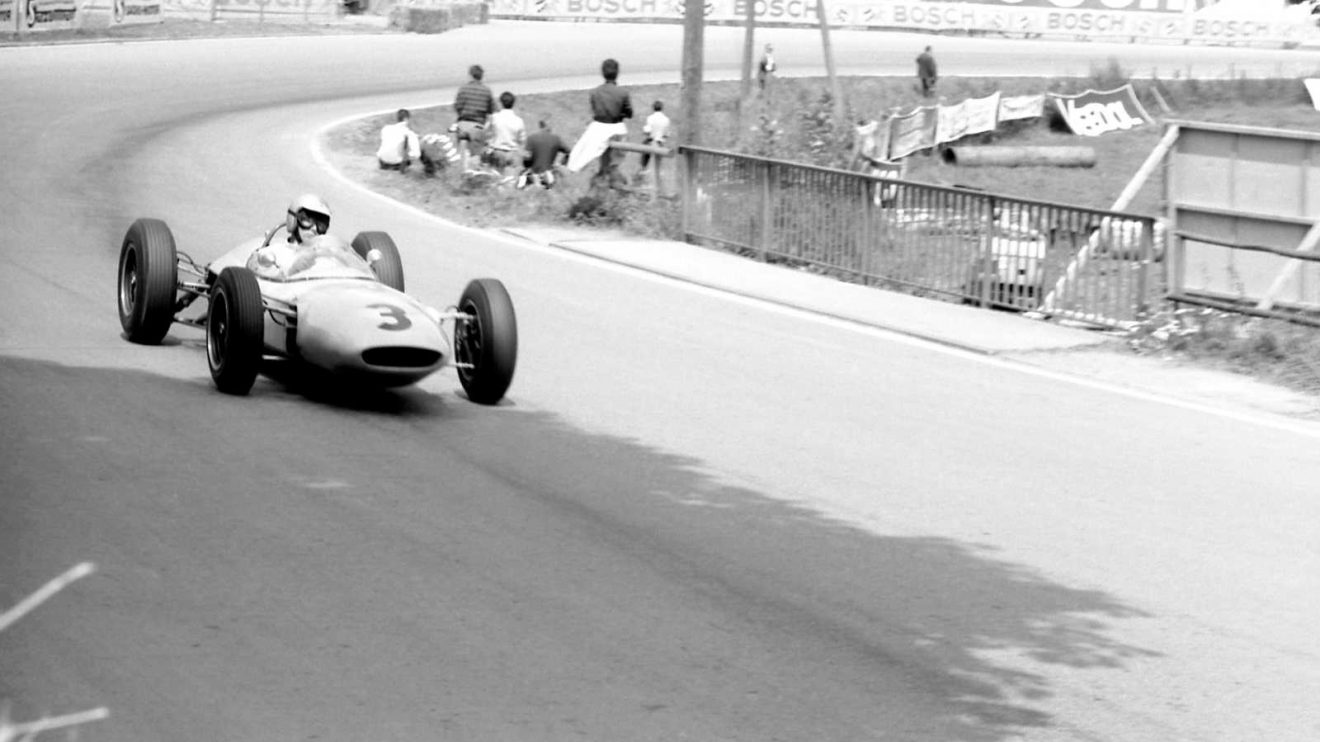
Jim Hall at the 1963 Solitude Grand Prix
Texas racer and designer Jim Hall is best known for his Chaparral sports cars, which raced in both the Canadian-American Challenge Cup and in international sports car races abroad. But as a young driver in the early 1960s, Hall also had a chance to compete in Formula 1.
Hall debuted at the 1960 United States Grand Prix in a self-entered and self-prepared Lotus and impressed with a seventh-place finish. In 1963, he headed over to Europe to contest a full season of F1. Here, he shares a fun story about feeling like he had “mastered” the ultra-challenging Nürburgring before ever racing his Lotus 24 there.
‘Boy, I really know this thing!’
When Jim Hall agreed to compete in Formula 1 full time in 1963, it came at a cost. He had just begun work on his first Chaparral, a groundbreaking sports car that became known as the 2A, when he received an offer from the British Racing Partnership to take on the F1 circuit.
At that time, BRP was in the midst of transitioning from becoming a privateer Lotus team to constructing its own cars — but Hall wasn’t going to be driving the BRM Mk1 like his teammate Innes Ireland. Instead, he took on the best of the racing world behind the wheel of an outdated Lotus 24.
The small, declining team had bitten off more than it could chew in trying to develop its own machine, and it would fold in 1964, the year after Hall competed.
But Hall didn’t know that at the time. All he knew was that he had been offered what appeared to be the chance of a lifetime, and he was going to seize it with both hands.
Unfortunately, Hall retired in his first two races at Monaco and Belgium. He finished the next two in the Netherlands and France, but well outside of the points. Finally, at the British Grand Prix, he finished sixth — good enough for a single point at the time.
And then came his excursion to the infamous Nürburgring.
This story is a tie-in to Elizabeth Blackstock’s podcast, “Deadly Passions, Terrible Joys.” Her latest episode centers on the death of the Chaparral 2J, a groundbreaking Can-Am car designed by the legendary Jim Hall.
More from “Deadly Passions, Terrible Joys”
? ‘Like riding a buffalo’ – The chaotic story behind Lella Lombardi’s NASCAR debut
? Meet the American driver who witnessed two of motorsport’s greatest tragedies
Each year, Hall hosts something called the “Party on the Patio,” where Chaparral fans of all stripes gather to hear Hall speak and watch his old cars cruise through the parking lot of the Permian Basin Petroleum Museum, there the cars are housed. This year, Hall recounted one particular story about the Nürburgring that firmly entertained the crowd.
“One of the most fun times we had was when we went to the Nürburgring,” he began. “It’s very difficult; I can’t remember how many miles long it was. And it’s got so many turns that you can’t even think about it.
“So, [my wife] Sandy and I bought a little Mini Cooper from John Cooper and drove it all over Europe. When we went [to the Nürburgring], I took a ride around with one of the racers that was there.
“We had gotten there a week early, so I just went around and around and around [the track] in my Mini, and I thought, ‘Boy, I really know this thing!’
“In any case, when race day came, I couldn’t believe how different it was.
“Your eye height in the Mini is up here,” Hall said, gesturing above his head, “and your eye height in the Formula 1 car is down here,” he said, gesturing near the floor.
“The turns didn’t look anything like the same! That surprised me, I’ll tell you that!
“But I hung in there, and there was some attrition, so I got points in that race.”
It would turn out to be Hall’s best-ever finish in Formula 1: fifth.
Though he competed in the subsequent three events in Italy, the USA, and Mexico and finished in the top 10 in all of them, Hall scored no additional points. The three he did accumulate during the duration of the season was good enough for 12th overall in the World Drivers’ Championship.
His teammate, Ireland, finished ninth that season, with six points.
The season wasn’t a particularly fruitful one for Hall, who quickly learned that it would be difficult to truly compete in Formula 1 without being offered top-tier equipment — and as his work on his new Chaparral 2A had shown him, he was tired of racing for other people.
Hall actively competed for just a few more years, and in Can-Am, he always raced machines he’d designed, manufactured, and prepared.
Read next: Audi Formula 1 power unit achieves ‘significant milestones’ in testing