

RB CEO reveals what went wrong with mid-season upgrades as correlation issue found


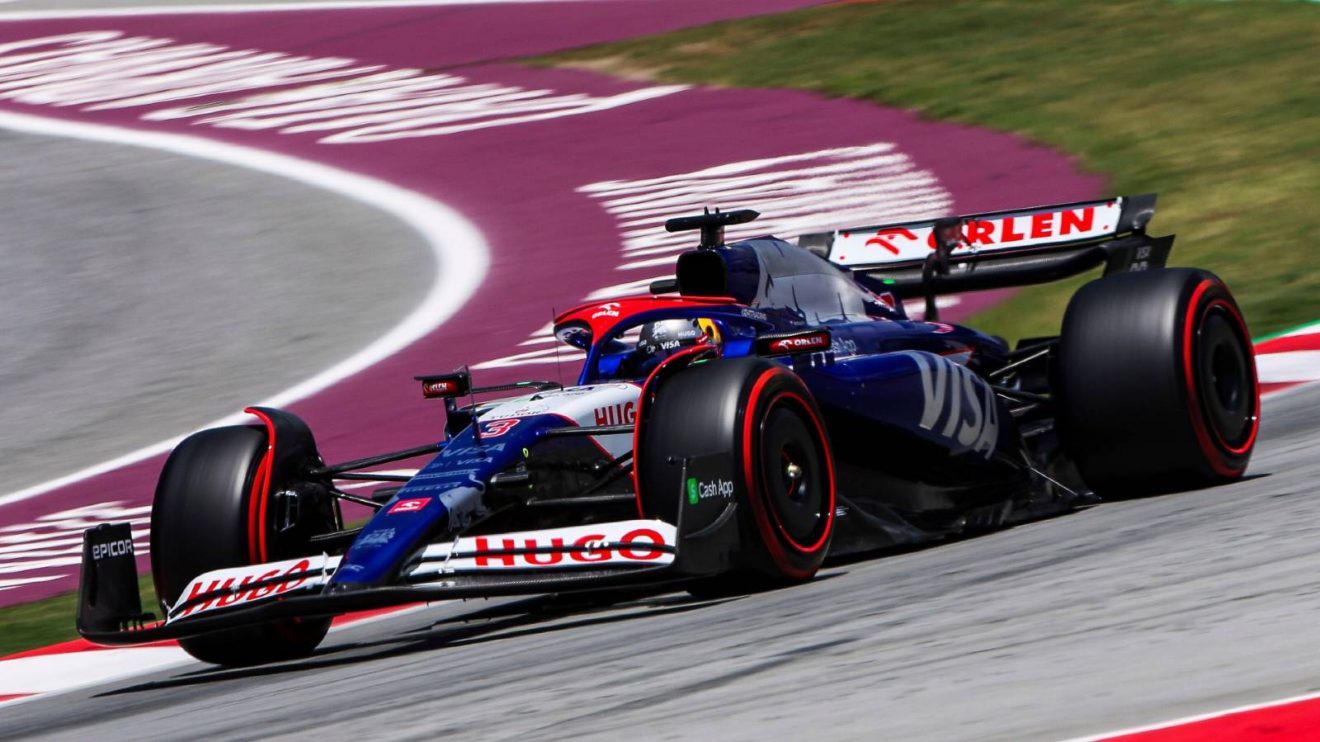
The upgrade package rolled out by VCARB during the Spanish Grand Prix had some correlation and manufacturing issues.
The upgrades introduced by the VCARB team over the Spanish Grand Prix weekend sapped the car’s performance, but CEO Peter Bayer is confident the issue has been alleviated.
The VCARB team rolled out for the Spanish Grand Prix with an updated floor, rear wing, and engine cover – only for Daniel Ricciardo and Yuki Tsunoda to put in the most subdued weekend the Faenza-based squad had encountered up to that point in the season.
Peter Bayer explains VCARB upgrade misstep
Having scored points in the previous four races, Spain saw the two VCARB cars come home well outside the points with 15th and 19th place. While not completely rowing back on the upgrades for the Austrian Grand Prix, using a mixture of old and new components for evaluation throughout the weekend at the Red Bull Ring brought the team back into the top 10.
This evaluation continued on for Silverstone, with the team having gotten to grips with what had and hadn’t worked from the upgrade package – allowing for the re-introduction of newer parts back onto the VCARB01.
With points finishes in both Austria and the UK, the issues thus seem alleviated – the team having understood its issues and responding quickly to ensure no mid-season slump.
But what exactly had gone wrong? After all, correlation concerns are words oft-used when the theoretical advances made by a team don’t translate to real-world components and performance.
Had it been a case of that theory backfiring for VCARB, or had it been something more simple, such as manufacturing defects or quality control issues?
“I think it was a couple of things,” VCARB CEO Peter Bayer told PlanetF1.com.
“First of all, because it’s so tight, we’re obviously pushing as hard as we can to keep the edge.
“Now, to push as hard as you can, what does that mean? Well, it means that, in the design process, you’re pushing the guys to go to the limit and, in the factory, you go to the limit, meaning we run three shifts at the moment producing the parts. Three shifts mean 24 [hours].
“The pressure is as high off-track as it is on track. In that process, there were a couple of things as far as I understand.
“There was a slight correlation issue with one of the aerodynamic parts. Because, ultimately, we’ve been very strong in slow corners, we’re not very good in terms of drag and efficiency so we tried to give up a bit of slow corner strength for high speed.
“And we did that. But, as we found out, we gave up a bit too much of slow-speed! So, once we understood that, we could go back.
“Then in terms of production, we had an issue with the rear wing, with a piece that was filled with aluminium. It turned out that aluminium was not strong enough to stand the load on the rear wing. It didn’t break, but it started to flop because it was not strong enough, ultimately.
“There was a small bit missing also on the wing, and, obviously, that could be fixed within a week and we had the new wing on the car [in Austria], where now the pieces are made of titanium and not of alloy, and it works.”
More on the latest VCARB F1 news
? Daniel Ricciardo’s ‘big hole’ hopes amid growing 2024 Red Bull speculation
? Yuki Tsunoda interview: Four burning questions including VCARB’s future
Peter Bayer praises calm precision as VCARB responds to upgrade concerns
With the issue taken care of almost immediately, allowing VCARB to respond with points finishes at the two races immediately following the introduction of the troubled upgrade package, Bayer said it had been imperative for him to ensure calmness within the squad.
“I think that the worst thing to do in that moment is to panic and to try and blame or be too proud and say ‘Oh, no, no, this will work’,” he said.
“It doesn’t work. Honestly, I have to say, the whole team was great.
“I’m quoting someone from our team, a new team member who said to me after the debrief, ‘Peter, this was quite amazing. I’ve never seen a team reacting so calmly, and so decisively in terms of saying, Okay, guys, Issue 1, 2, 3, 4, 5 – you take care of that, and we’ll meet again in two hours, and we’ll get this. If we don’t get it today, we’ll get it next week.’
“This guy has been in more than one Formula 1 team.
“Honestly, it was a superb job by the team. There’s a simpler way of doing this, all of us have to be performance-obsessed, meaning that, if we see that something’s not working, let’s try and fix it proactively.
“Let’s not wait until your neighbour is picking up the ball – you go yourself, you do it, you pick it up, you fix it with the help of the people who know how to do it.
“No blame, don’t finger-point. And on top of not blaming, we need to know the truth. So no bullsh*t!”
Heading into the Silverstone weekend, Ricciardo confirmed that the mixture of parts fitted to the car was a mixture, half and half, of new versus old parts and said the upgraded parts that hadn’t worked out had still allowed the team to better understand what had gone wrong in relation to the theory.
“It’s not unlikely to have some downgrades through the season. They’re not, unfortunately, all upgrades!” he said.
“But, up until that point, I felt everything we were putting on the car worked and was giving us performance. So yeah, it’s also okay to understand why it didn’t work so that what we bring moving forward is obviously going to benefit us.
“So yeah, a little bit of understanding to take place, but we have confidence that we now have, currently, the best parts on the car.”
Read Next: Toyota issues response over F1 2025 rumours as Haas speculation swirls